

PRODAS has become the world standard for integrated weapon design tools.
PRODAS V3.5 is the world’s only integrated software system specifically designed to analyse all types of projectiles.
From the smallest match bullets to GPS guided artillery shells, PRODAS brings together:
Tailor PRODAS To Meet Your Needs By Adding Optional Analysis Modules
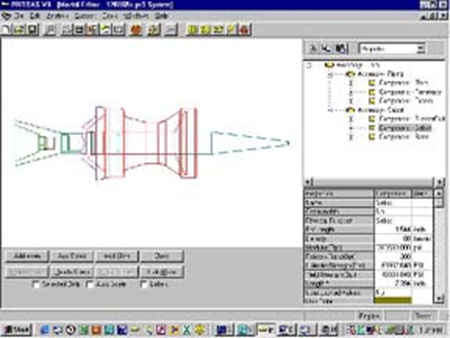
Projectiles are quickly created using the PRODAS model editor.
Designed and optimized for projectiles, it is much quicker and easier to use than a standard CAD package.
Drag and drop projectile assemblies or components from one projectile to another.
Trace a Bitmap
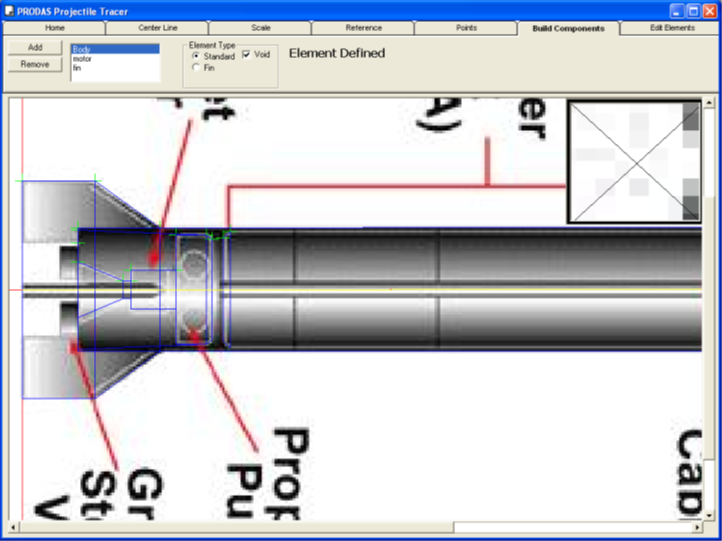
The optional module Projectile Tracing Tool will allow you to quickly build a model from an bitmap of a cross section.
Click HERE for more information
DXF & IGES File Write!
PRODAS V3 can create IGES (V 4.0) & DXF Files for easy output to CAD Systems.
Logical Model Structure
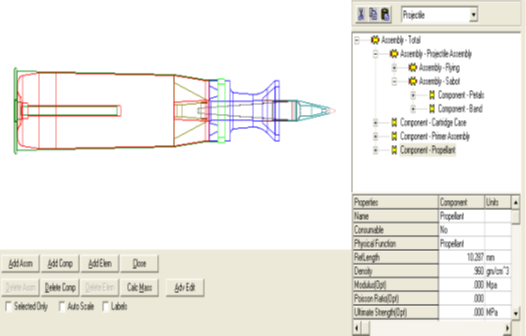
Simple Elements are combined to describe the geometry of Components. Material properties are defined at the component level. A Material Reference Book is included to ease this process. Components are combined to make up Assemblies. Assemblies can be combined to form higher level assemblies.
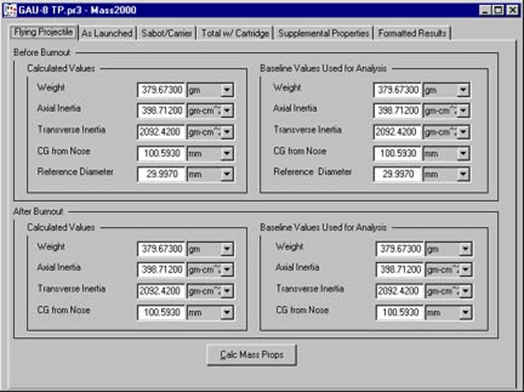
Calculate weights, inertias and CG from the model
Mass property results are stored in the projectile file to be used in subsequent analysis.
Experimental data can be entered and “locked”. The system will use this data and calculate only the unknown values.
Properties are calculated before and after burnout of a rocket motor or fumer.

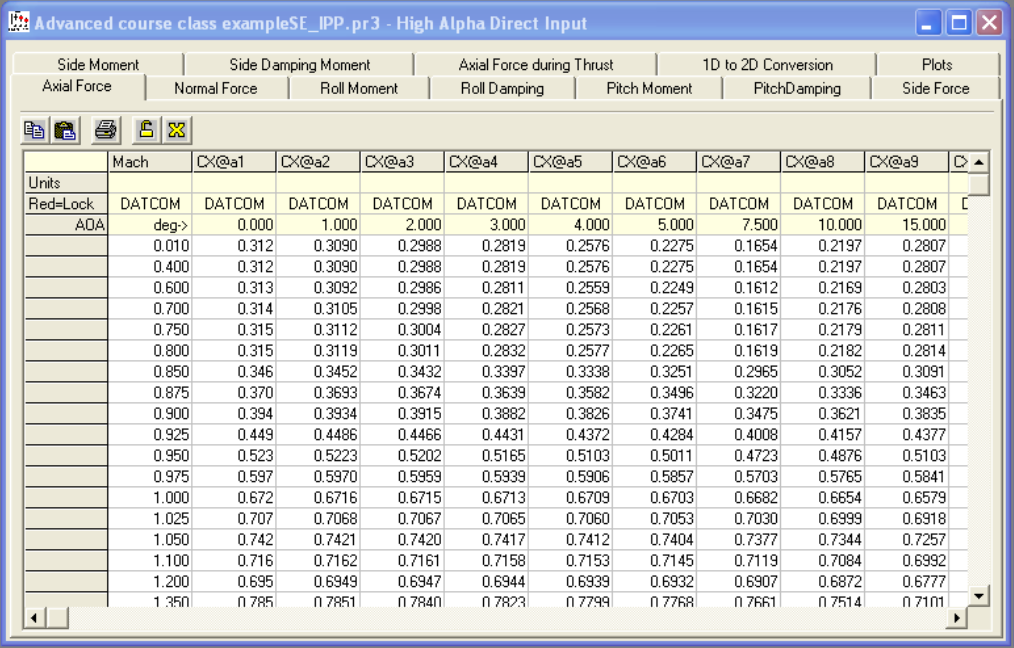
Computes a complete set of aerodynamic force and moment coefficients!
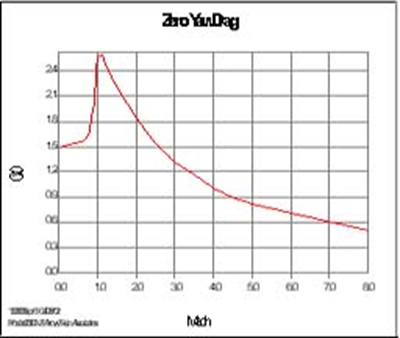
Includes analysis capabilities for
Keep them flying STRAIGHT
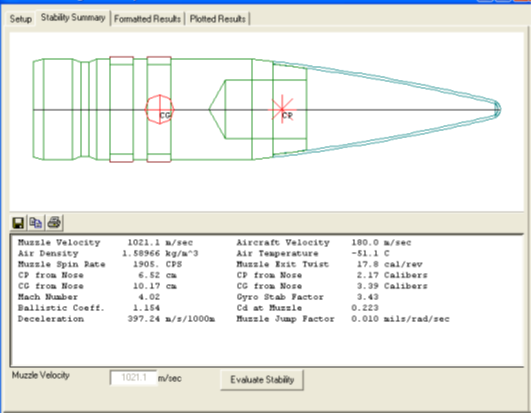
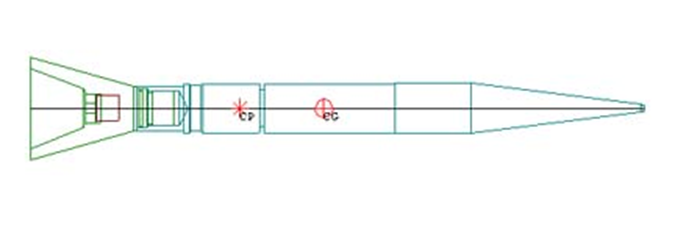
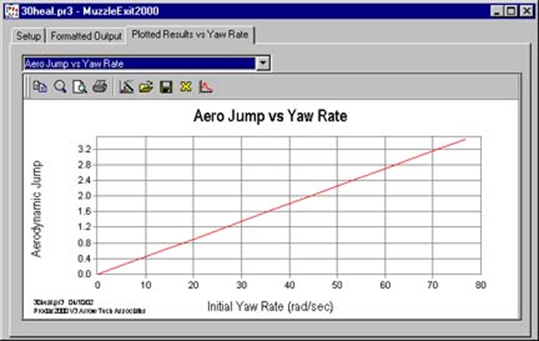
Estimate projectile dispersion from in-bore clearances, and/or C.G. offset.
Perform Dispersion Sensitivity Analysis
Determine Muzzle Exit Effect
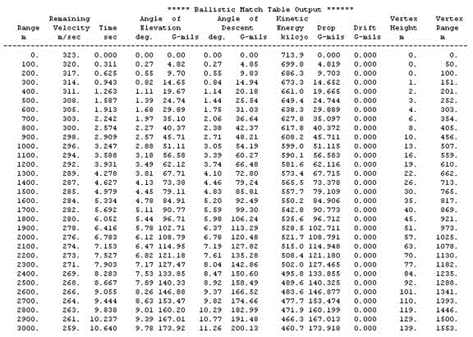
A statistical simulation for estimating the long term pass probability of Lot Acceptance Tests with various pass criteria.
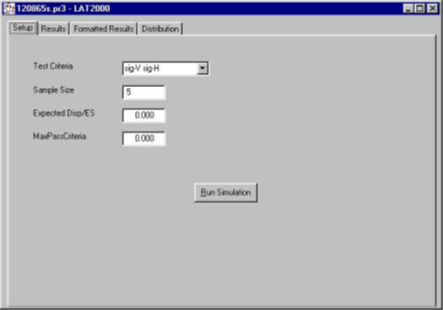
Inputs
Current (or expected) Projectile Performance
Five thousand (5000) LAT’s are simulated, and individual results are accumulated. Mean dispersion, dispersion standard deviation and probability of passing the test are output.
The standard deviation in mean point of impact (MPI) is also displayed to assist system engineers in assessing statistical variability of a burst center point as a function of ammunition dispersion and the number of rounds fired in a burst.
Series of target cards
•Record total angle of attack & pointing vector
change vs. distance from muzzle
Advantages:
Provides:
Drawbacks:
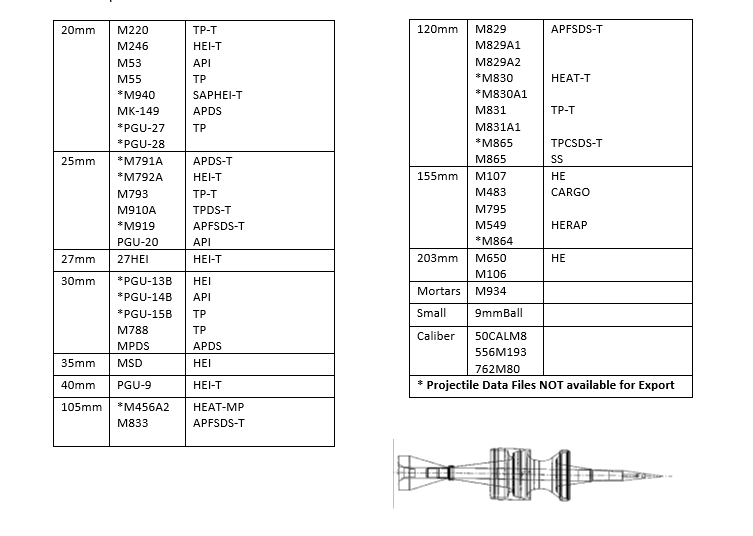
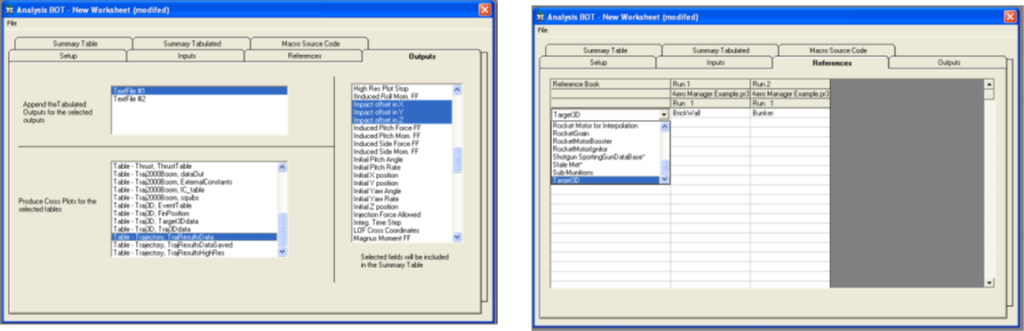
Create Macro Scripts automatically with the Analysis BOT. Using the Analysis BOT interface desig-nate the projectile models, desired analysis, input variables and desired output. The Analysis BOT will then automatically generate the Macro Script. The user can then save the Analysis BOT workbook or Macro Script for future changes or customization. The script can be accessed in the future via the “Tools” menu. The Analysis BOT is included with any of the Gun System Effectiveness modules or can be purchased separately.
Select an Analysis Module
•All analysis modules enabled on your machine will be contained in the drop down list box
•Select the module you want to exercise
Select one or more PR3 files
•You can;
•Browse the projectile of interest
•Enter a unique comments
•Click on the “Add” button.
•The Comment will be added to help identify the run
•You can uncheck a run to temporarily remove it from the execution
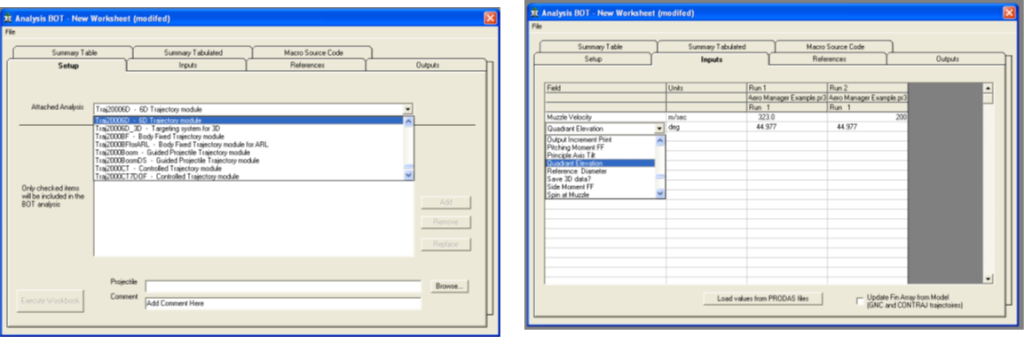
Different aerodynamic estimation algorithms will produce different sets of aerodynamics. Each algorithm has its strengths and weaknesses, for example one may do a good job on drag, but another does better on normal force. But each will develop a complete set of aerodynamics. Add to this aero data generated during testing and one can quickly be-come overwhelmed with numbers.
The PRODAS Aero Manager was developed to help to help the aero ballistician manage this potential mountain of aerodynamic data.
Aero coefficients from different sources are cross plotted against each other. Experi-mental data can be added in as well. The user can then use any source as a starting set and then change all points or even individual points to better fit their engineering judg-ment. These modified tables can then be used to drive the other PRODAS analyses.
The Aero Manager is included at no charge when you purchase an option aero estimation code such as MISL3.
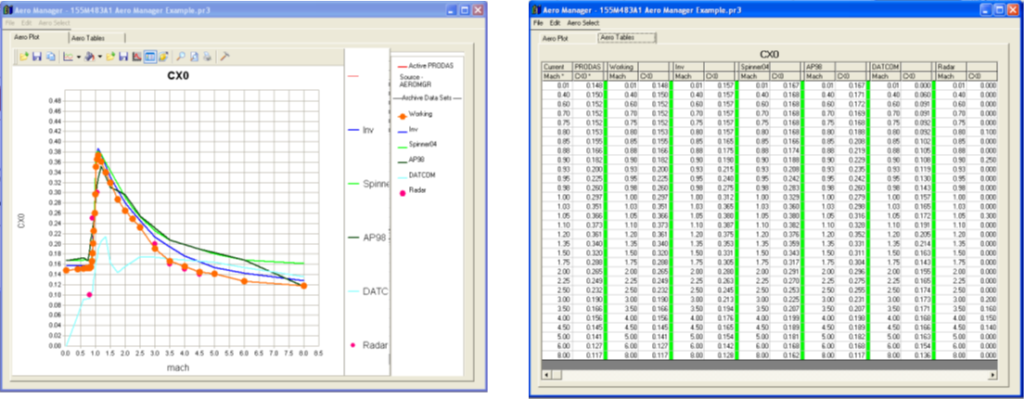
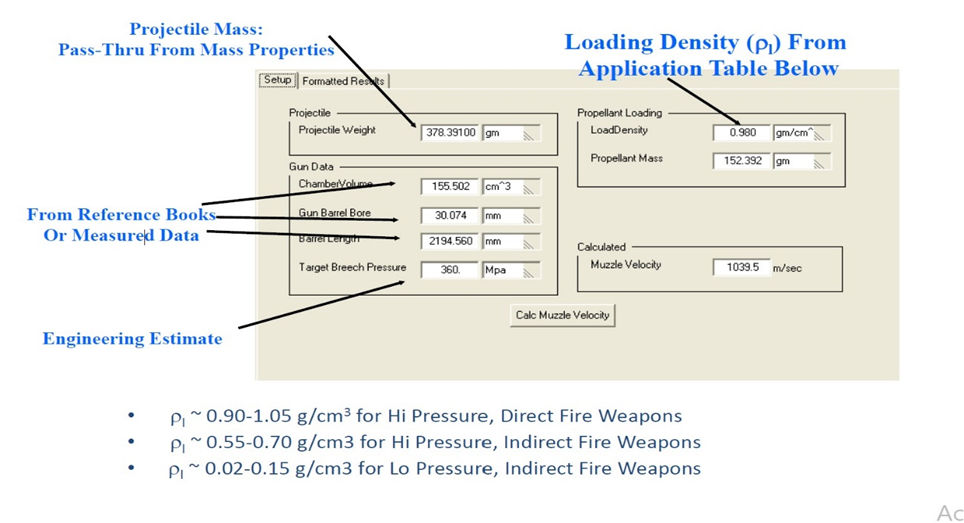
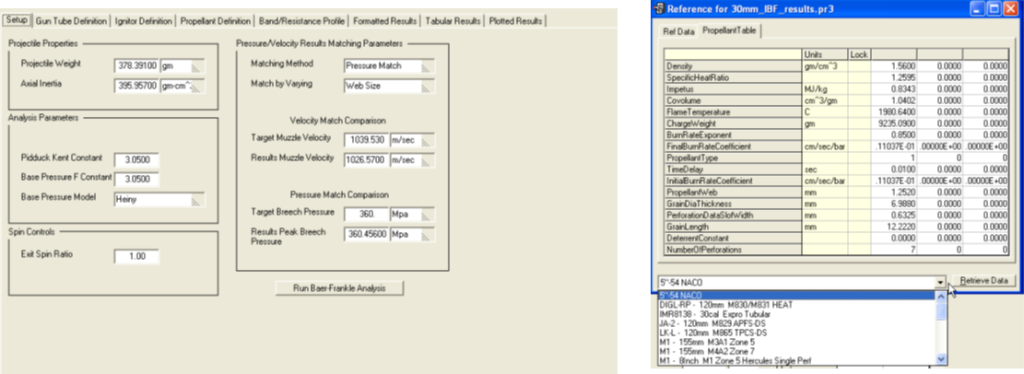
Contains both Empirical Database and Numerical Integration Interior Ballistics routines
Reference libraries are provided with detailed information on propellant geometry and burn characteristics as well as igniter and gun parameters.
PRODAS V3.5 has a complete computational suite to assess the terminal effectiveness of warheads. Armor penetration of kinetic energy penetrators, and the fragmentation of high explosive warheads, can all be easily, quickly, and accurately assessed.
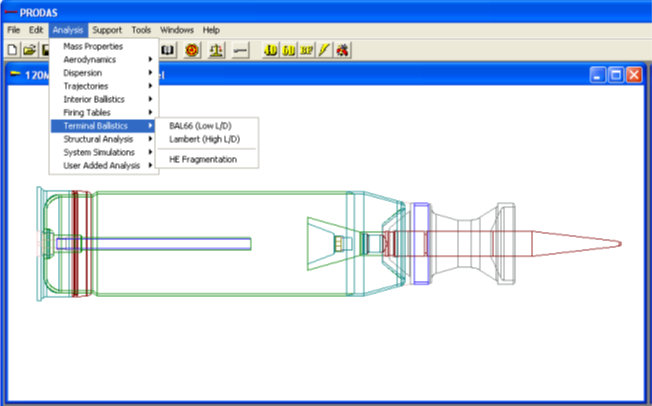
Select from two closed-form penetration prediction algorithms based on the penetrator length-to-diameter ratio:
Gurney-Mott-Sarmousakis methodology to predict the fly-off velocity, spray angle, and fragment mass distribution of naturally fragmenting projectile bodies.
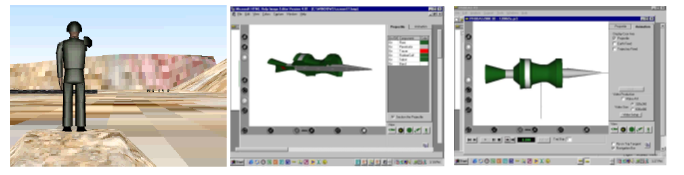
Generate visuals of your model in 3D solids. Position the model in any orientation, sec-tion it and produce movies of your projectile in flight. Simulated firing ranges, gunner and target images are provided to increase the impact of these movies. The 3D Visualizer has the ability to animate projectile motion in flight.
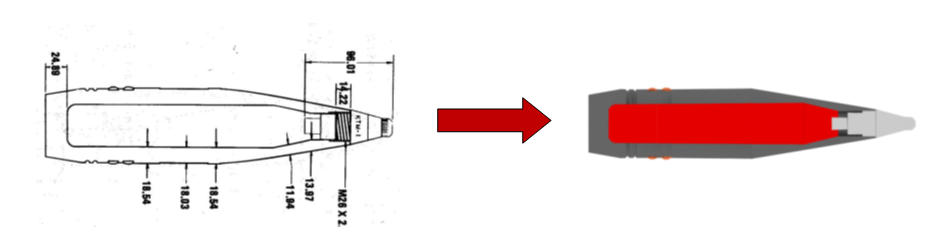
Whether the image comes from the Web, a brochure or a photo-graph of a sectioned projectile, you can now quickly build an accurate PRODAS model with a couple of clicks of the mouse.

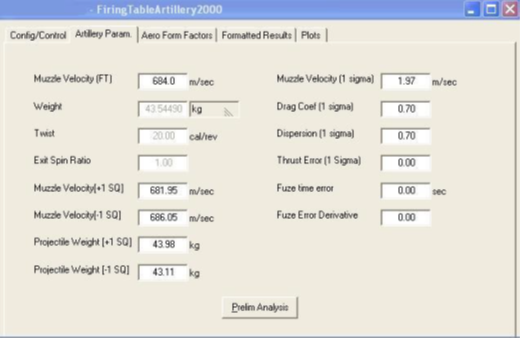
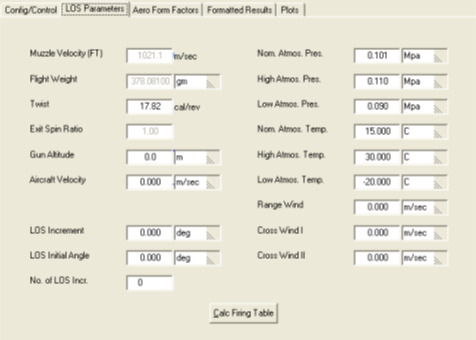
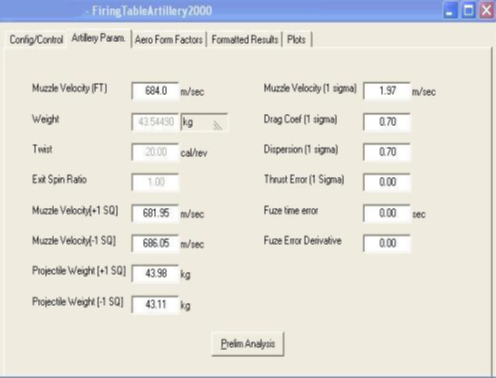
Firing Tables, including sensitivity factors, can be generated easily in minutes.
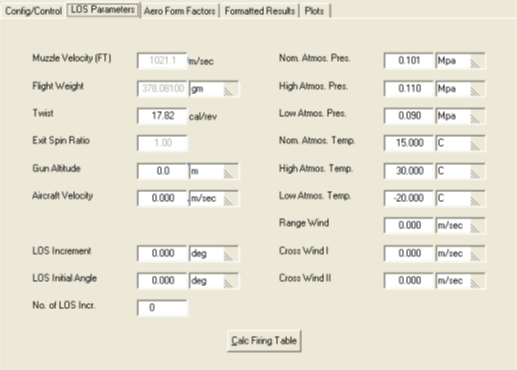
Purpose – Enable PRODAS users to produce key tables in NATO STANAG 4119 format
•Accurate angular motion due to winds
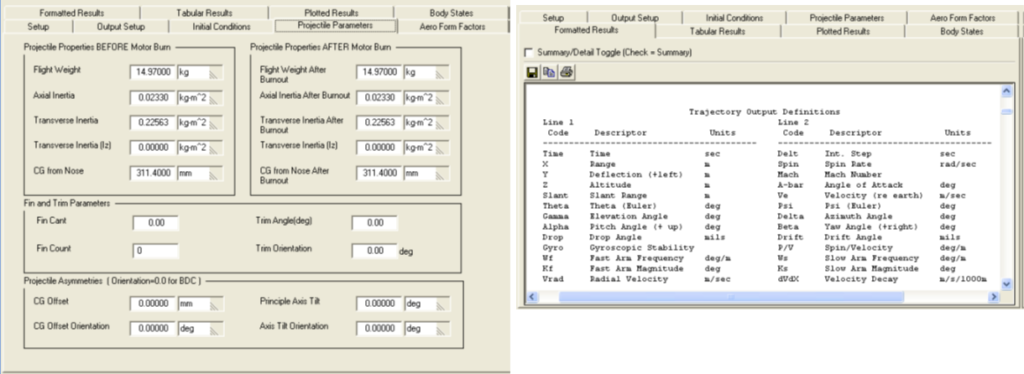
Along with the 4 and 6 degree of freedom fixed plane trajectory simulations (The projectile ro-tates within the axis system) PRODAS also has 6 Degree of freedom Body Fixed simulation modules. In the body fixed trajectories the projectile axis rotates with the projectile allowing simulation of asymmetric physical properties (Cg offset and Principle axis tilt), trim angles and the resulting launch and downrange effects. Outputs include the standard trajectory output and the body states of the projectile.
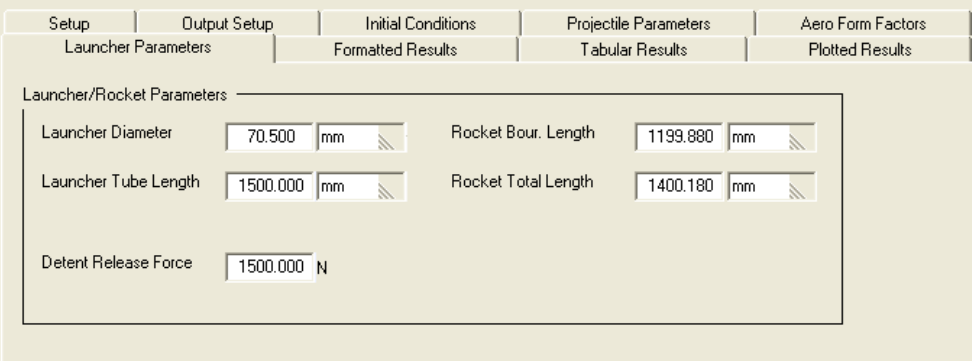
Additional options include rocket launcher simulation where the launch-er parameters such as launcher diame-ter, launcher length, release détente force, rocket bourelet length, and total rocket length are input. This algo-rithm then calculates the in launcher velocity, spin generated by the input thrust vs. time curve or launcher ri-fling and angular motion at exit caused by gravity drop. These exit conditions are then transferred to the initial con-ditions of the Body fixed 6DOF to continue the flight simulation down-range.

Now use our own software development tools to efficiently integrate your in-house developed analyses with PRODAS V3.5
Customize PRODAS for your business with the Software Development Kit
Three tools are provided with the Software Development Kit
Multiple sources can be analyzed within the Aero Manager
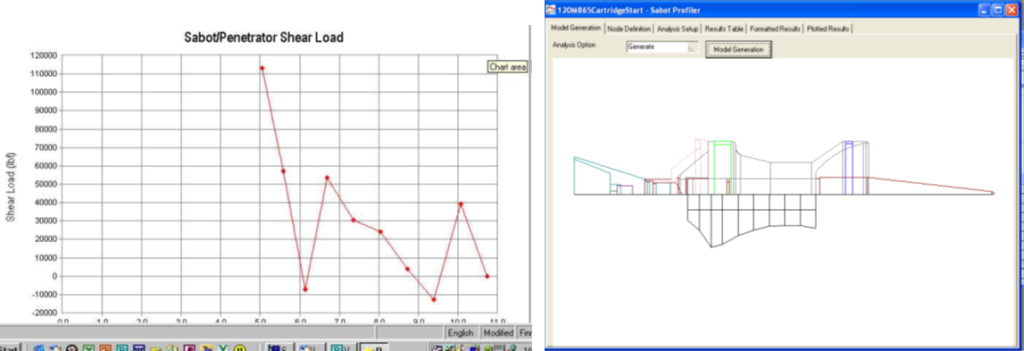
The Sabot Profiler is a one dimensional structural analysis of the projectile/sabot system caused by longitudinal accelerations within the barrel. The software calculates the nominal axial stress distribution along the length of the projectile and can be used to optimize the the shape (mass) of the selected piece parts, primarily sabots for long rod applications. The pre-dicted stress levels obtained are very close to those obtained by more detailed Finite Ele-ment Method (FEM) solutions. Therefore, Profiler can be used as an efficient optimization tool.
The output parameters calculated for the projectile/sabot system caused by the longitudinal accelerations within the barrel are then used to perform the In Bore Balloting analysis.
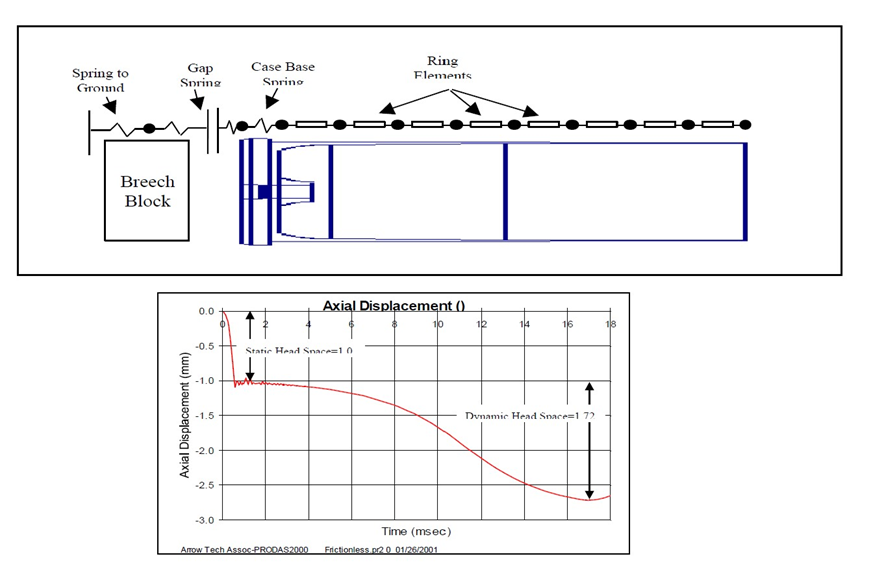
Simulate Case Deflections & Chamber Interaction during firing pressurization
The modeling and analysis of a cartridge case requires an elastic-plastic, thermal, dynamic solution. The use of general purpose finite element programs for case analysis can be very expensive and la-bor intensive because the model must contain many elements to obtain stress distributions in the thin cylindrical wall region of the case and in the base region. Additionally, the case material can exceed its yield point for a large part of the interior ballistic cycle, requiring an inelastic analysis with relatively long computation times.
To improve computational and parametric design efficiency, Arrow Tech Associates, Inc. has de-veloped an analytical tool specifically to analyze cartridge cases, called CASAS (CASe Analysis System).
CASAS is a primary analytical tool to perform the elastic-plastic, dynamic analysis (including tran-sient heat effects) required for cartridge case design.
Complete simulation of projectile/gun interaction during interior ballistics cycle and then flyout to target
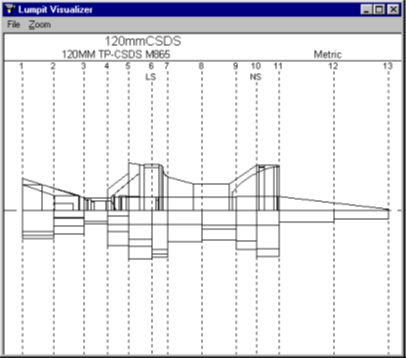
Simulates the Dynamic Response and Interaction of a Flexible Projectile and a Flexible Gun Tube During In-Bore Travel
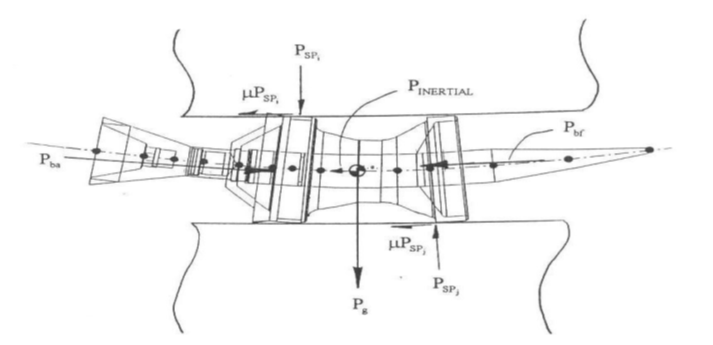
Using BALANS you can describe the projectile and tube with up to 50 lumped mass nodes and connecting beams each, compute the deflection of the projectile and gun tube during movement of the projectile from breech to muzzle exit and, determine the balloting contribution to disper-sion.
BALANS analyzes the dynamic response and interaction of a statistically representative, flexible projectile and a flexible gun tube during in-bore travel., in a time step iterative solution. BALANS assumes the projectile is initially misaligned in the gun tube due to manufacturing tol-erances. During firing, this misalignment produces secondary forces causing transverse dis-placement and yawing motion of the projectile as it travels from breech to muzzle.
The resulting yaw angle and angular rate at muzzle exit are then analyzed for their effect on dis-persion.
•Monte Carlo error Sources
•Run Internal Balloting on 500 cases
•Collect Angular Rates at Muzzle
•Run Body Fixed Six Dof for each set of angular rates to target impact
•Calculate dispersion performance on target
The following optional analysis modules are advanced PRODAS modules and require the PRODAS Main Analysis in order to run. All four of these modules includes the Analysis BOT module (AT639/A)
The system effectiveness series of analyzes are designed to evaluate the lethality of gun-ammunition-fire control systems against a variety of targets.
There are analysis modules designed to evaluate many different missions:
Using this suite of tools, you can quickly evaluate candidate ammunition and gun systems, burst lengths, targets, sensor errors and system accuracy. Analysis output is focused on the effectiveness in hitting and killing the intended target. Subsequent analysis (maintainability, reability, affordability, life cycle) is required to determine cost effective solution parameters.
Fighter aircraft engagements with single and multi barrel sys-tems.
•Lethal area of target
Helicopter, Fixed Wing engaging armored or materiel targets. Both Gun and Ground Attack Missile
Air Defense, Missile Defense, UAV Engagement, Impro-vised Munition Engagement
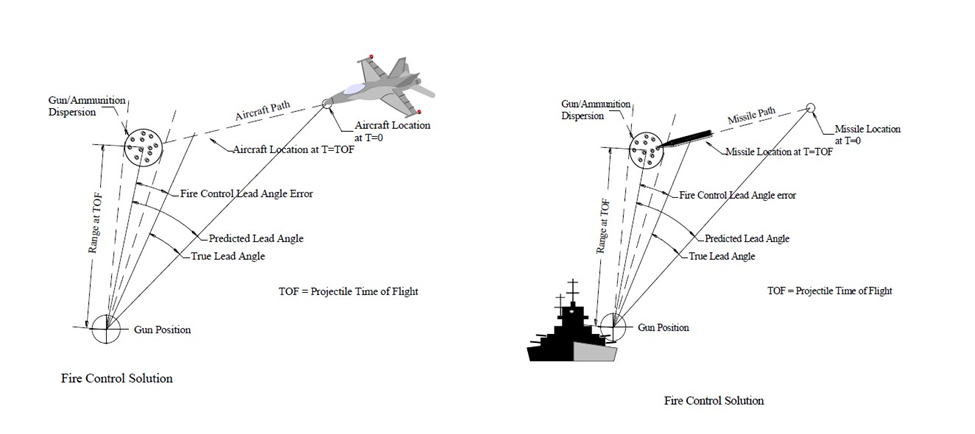
Vehicle to Vehicle, Dismounted Troops, Direct and Indirect fire missions, Point Detonating and Air Burst Fuzing. Projectile and Artillery Rockets
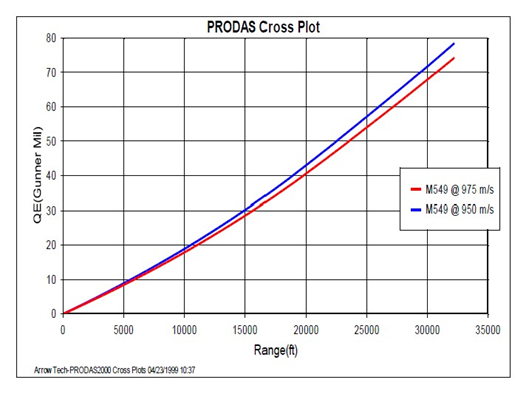
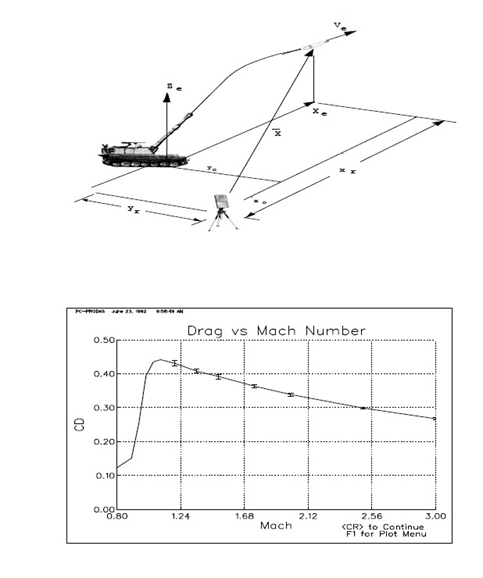
Accurate Extraction of Drag Coefficients and Tracer Performance from Doppler Radar Data
RADAR 2000 uses the equations of motion along with non-linear drag versus Mach Number for the most accurate computation of drag coefficients possible. A powerful differential correction technique is used to rapidly converge on a combination of selected coefficients which most accurately matches the experimental radar data.
This program was developed on main frame computers and has been used to reduce radar data for both
RADAR 2000 features:
RADAR Assistant Features:
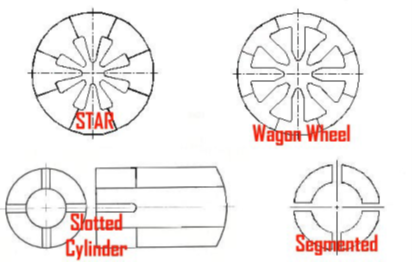
The Rocket Motor Design Tool module of PRODAS are rocket motor interior ballistic codes written by Talley Defense which provide a transient, dynamic burn model for four (4) specific rocket motor grain geometries: Segmented, Star, Slotted, and Wagon Wheel
Surface geometry computations, along with thermochemical and gas dynamics equations allow computation of internal combustion pressure, thrust, impulse, mass flow, surface area and web as a function of time.
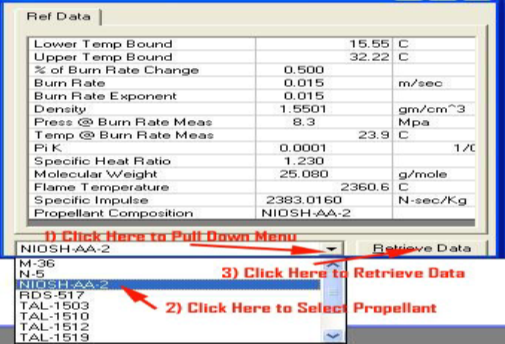
Combustion properties of standard rocket motor propellant grains are loaded from a PRODAS Reference Book, as shown below:
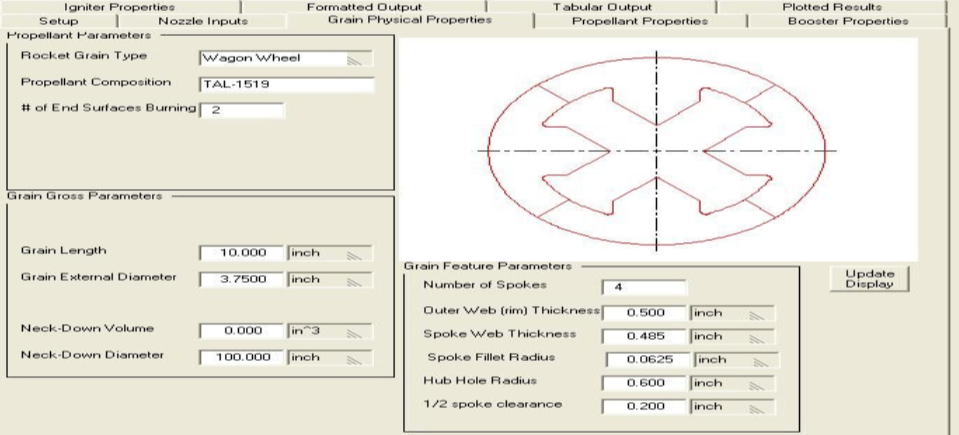
The effects of nozzle geometry, grain geometry, propellant burn rate, propellant thermochemi-cal properties, igniter properties and booster properties on rocket motor performance can be as-sessed.
Hand-off of rocket motor thrust vs. time to either 4 degree-of-freedom (DoF) or 6 DoF trajecto-ry modules is automatic within the PRODAS environment, providing the user with an accurate, close coupled simulation ideal for assessing the performance of either ballistic or guided rocket systems, including dispersion.
Six Degree of Freedom Control Flight Simulation Program for Fin Control, Lateral Thrust, or Impulse Control
Use a 6DOF Trajectory Simulation to evaluate response to control inputs from fins, canards and squibs. Control inputs are pre-programmed and applied during the trajectory.
Determine the efficiency and capability of a control method as implemented on your flight vehicle de-sign. Perform this critical step in the development of a guided flight vehicle before moving on to a full guided vehicle simulation such as the Guidance Navigation and Control Simulation Module (AT 630).
The six degree of freedom (6DOF) Control Flight Simulation Program (CONTRAJ) evaluates flight performance, provide trade-offs, and design verification. Pre-programmed control phases are defined during the input phase of operation. CONTRAJ allows for two types of control concepts, (1) fin con-trol, and (2) lateral thrust or impulse control. The flight dynamic equations of motion are developed relative to a body-fixed reference frame. Asymmetries in both mass and aerodynamics can be includ-ed.
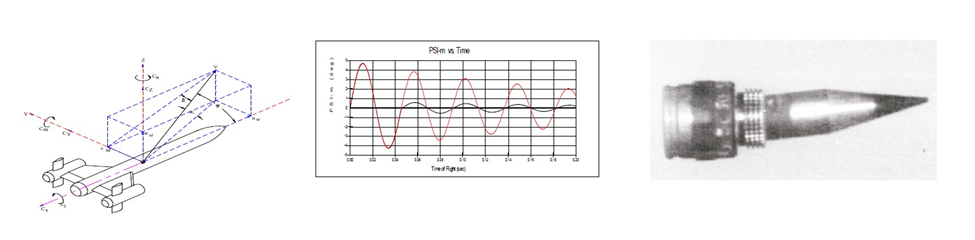
CONTRAJ includes two 6DOF equations of motion models. The fixed plane model requires mass and aerodynamic symmetry with the exception of slight aerodynamic asymmetries such as trims or roll induced effects. The body fixed model allows both inertial and aerodynamic asymmetries such as an airplane configuration.
1. 6DOF – Fixed Plane – non rotating coordinate system
2. 6DOF – Body Fixed – rotating coordinate system
CONTRAJ can be used to assess the control authority of guided projectile with various flight control concepts, or assess the angle of attack developed and flight path deviation of ballistic projectiles sub-jected to external disturbances (e.g. sabot discard)
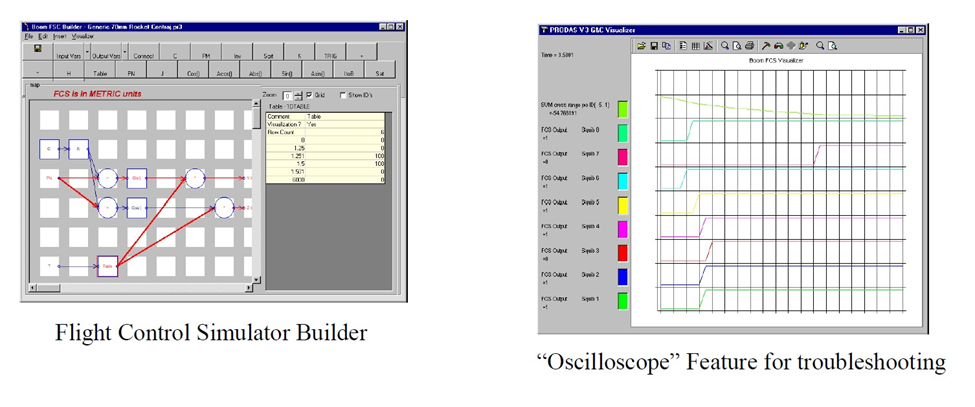
This unique module combines a guidance and control simulation with a body fixed 6DOF trajectory simulation. A drag and drop editor is provided to quickly build a flight control system from common control system elements. Also provided is an “oscilloscope” feature to help design and troubleshoot the control system. This analysis module is a powerful develop-ment tool where trade studies can be completed quickly, getting you r design ready for final modeling and analysis using the Guidance Navigation and Control Simulink Builder (AT-645/A).
A wide variety of control system building blocks are available including: gain, sum, multi-ply, state specific filters, polynomial filters, trigonometric functions, triggers, sample and hold, accelerometers, inertial to body transformations, single axis transformations, constants, table look ups etc. The user constructs a control system by appropriately arranging control system building blocks. The software properly couples all control system elements together. Any physical parameter of the projectile model can be dynamically controlled. With this ar-rangement, virtually any projectile or missile flight control system can be modeled in detail.
PRODAS is known for its seamless integration of analysis and simulation software tools from various disciplines in a graphical environment with a simple user interface. Now PRODAS has taken a dramatic leap forward by integrating with MATLAB® and Simulink®. The MATLAB® world is massive with general purpose programming and scientific computation and toolbox and blockset extensions for specific applications. With the integration of this powerful capability into PRODAS, a new paradigm of rapid and reliable system simulation for smart munitions is made possible.
MATLAB/Simulink Trajectory Module Features;
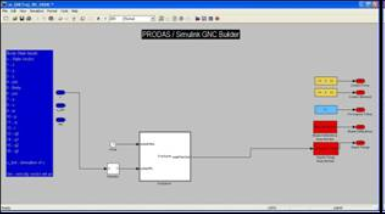
Modeling in Simulink®
PRODAS Blockset – Leverage the highly validated PRODAS 6+DOF trajectory block as the starting point for your simulation.
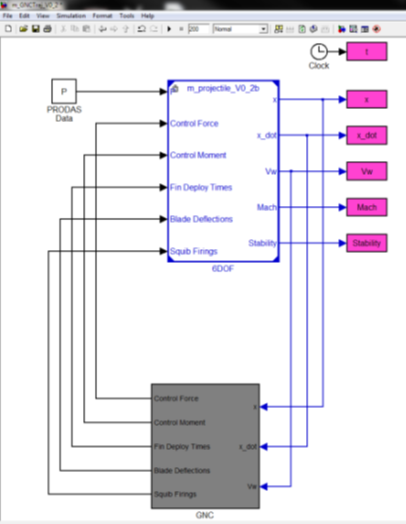
Use lower-level blocks to build your own trajectory module such as aerodynam-ics, mass properties, rocket motor, squibs, and more. Customize any PRODAS block to meet your specific modeling needs.
100% Compatibility with All Simulink® Blocksets – Use any of your licensed Math Works products to build your simulation. The integra-tion with PRODAS does not place any restrictions on what you can do with MATLAB® and Simulink®.
Design Your Guidance, Navigation, and Control (GNC)
Sys-tem – Use the PRODAS blockset, the Aerospace blockset, and your own custom blocks to design the GNC system. The de-fault template provides an empty GNC subsystem with all the connections to the 6+DOF to enable close-loop control.
For More Details CLICK HERE